
Principles of Geometry


Principles of Geometry
Regular price
Checking stock...
Regular price
Checking stock...
Zusammenfassung
Henry Frederick Baker (1866–1956) was a renowned British mathematician specialising in algebraic geometry. First published between 1922 and 1925, this six-volume work provides a detailed insight into the geometry which was developing at the time of publication. Volume 2 describes the principal configurations of space of two dimensions.
The feel-good place to buy books
- Free delivery in the UK
- Supporting authors with AuthorSHARE
- 100% recyclable packaging
- B Corp - kinder to people and planet
- Buy-back with World of Books - Sell Your Books
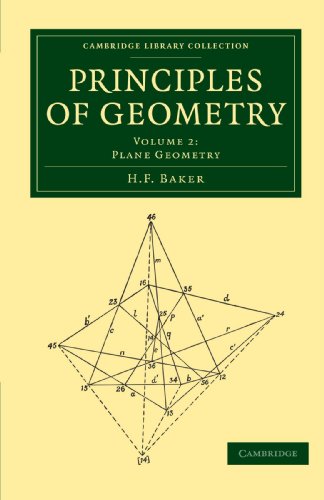
Principles of Geometry by H F Baker
Henry Frederick Baker (1866–1956) was a renowned British mathematician specialising in algebraic geometry. He was elected a Fellow of the Royal Society in 1898 and appointed the Lowndean Professor of Astronomy and Geometry in the University of Cambridge in 1914. First published between 1922 and 1925, the six-volume Principles of Geometry was a synthesis of Baker's lecture series on geometry and was the first British work on geometry to use axiomatic methods without the use of co-ordinates. The first four volumes describe the projective geometry of space of between two and five dimensions, with the last two volumes reflecting Baker's later research interests in the birational theory of surfaces. The work as a whole provides a detailed insight into the geometry which was developing at the time of publication. This, the second volume, describes the principal configurations of space of two dimensions.| SKU | Nicht verfügbar |
| ISBN 13 | 9781108017787 |
| ISBN 10 | 1108017789 |
| Titel | Principles of Geometry |
| Autor | H.F.Baker |
| Serie | Cambridge Library Collection - Mathematics |
| Buchzustand | Nicht verfügbar |
| Bindungsart | Paperback |
| Verlag | Cambridge University Press |
| Erscheinungsjahr | 2010-10-31 |
| Seitenanzahl | 266 |
| Hinweis auf dem Einband | Die Abbildung des Buches dient nur Illustrationszwecken, die tatsächliche Bindung, das Cover und die Auflage können sich davon unterscheiden. |
| Hinweis | Nicht verfügbar |