
Three Critics of the Enlightenment


Three Critics of the Enlightenment
Regular price
Checking stock...
Regular price
Checking stock...
World of Books
At World of Books, you’ll find millions of preloved reads at great prices, from bestsellers to hidden gems. Every book you buy saves money and helps reduce waste, so you can read more for less while giving stories a second life.
The feel-good place to buy books
- Free US shipping over $15
- Buying preloved emits 41% less CO2 than new
- Millions of affordable books
- Give your books a new home - sell them back to us!
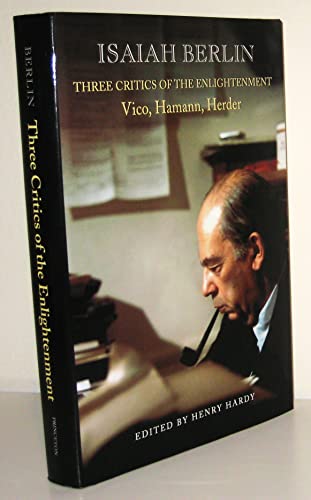
Three Critics of the Enlightenment by Isaiah Berlin
Isaiah Berlin was deeply admired during his life, but his full contribution was perhaps underestimated because of his preference for the long essay form. The efforts of Henry Hardy to edit Berlin's work and reintroduce it to a broad, eager readership have gone far to remedy this. Now, Princeton is pleased to return to print, under one cover, Berlin's essays on Vico, Hamann, and Herder. These essays on three relatively uncelebrated thinkers are not marginal ruminations, but rather among Berlin's most important studies in the history of ideas. They are integral to his central project: the critical recovery of the ideas of the Counter-Enlightenment and the explanation of its appeal and consequences--both positive and (often) tragic. Giambattista Vico was the anachronistic and impoverished Neapolitan philosopher sometimes credited with founding the human sciences. He opposed Enlightenment methods as cold and fallacious. J. G. Hamann was a pious, cranky dilettante in a peripheral German city. But he was brilliant enough to gain the audience of Kant, Goethe, and Moses Mendelssohn. In Hamann's chaotic and long-ignored writings, Berlin finds the first strong attack on Enlightenment rationalism and a wholly original source of the coming swell of romanticism. Johann Gottfried Herder, the progenitor of populism and European nationalism, rejected universalism and rationalism but championed cultural pluralism. Individually, these fascinating intellectual biographies reveal Berlin's own great intelligence, learning, and generosity, as well as the passionate genius of his subjects. Together, they constitute an arresting interpretation of romanticism's precursors. In Hamann's railings and the more considered writings of Vico and Herder, Berlin finds critics of the Enlightenment worthy of our careful attention. But he identifies much that is misguided in their rejection of universal values, rationalism, and science. With his customary emphasis on the frightening power of ideas, Berlin traces much of the next centuries' irrationalism and suffering to the historicism and particularism they advocated. What Berlin has to say about these long-dead thinkers--in appreciation and dissent--is remarkably timely in a day when Enlightenment beliefs are being challenged not just by academics but by politicians and by powerful nationalist and fundamentalist movements. The study of J. G. Hamann was originally published under the title The Magus of the North: J. G. Hamann and the Origins of Modern Irrationalism. The essays on Vico and Herder were originally published as Vico and Herder: Two Studies in the History of Ideas. Both are out of print.
"Isaiah Berlin's main preoccupation throughout his productive life was understand the nature of the modern reaction against the EnlightenmentThese essays on Vico, Herder, and Hamann belong with his other profound and influential studies of the leading figures of what he called the Counter-Enlightenment. But they are also crucial for anyone hoping to understand Berlin's own analysis of modern life and politics, which has received increasing attention in recent years. Anyone interested in Berlin or those he studied will find this an essential volume."—Mark Lilla, University of Chicago
"Isaiah Berlin is among the finest intellectual historians of recent decades. Yet his position is somewhat peculiar: for while he is clearly a scholar of enormous erudition, the characteristic style of his work is closer to that of brilliant conversation than of conventional historical scholarship. His works on Vico, Herder, and Hamann deal with thinkers who were at odds with main currents of the Enlightenment. For anyone with a historical sense, the recrudescence of so many of the characteristic notions of the 'Counter-Enlightenment' under the rubric of 'postmodernism' is striking. The recovery of these ideas is all the more effective for being a critical one: Berlin reminds his readers of some of the unfortunate historical consequences of the ideas in question."—Jerry Z. Muller, Catholic University of America
"Isaiah Berlin is among the finest intellectual historians of recent decades. Yet his position is somewhat peculiar: for while he is clearly a scholar of enormous erudition, the characteristic style of his work is closer to that of brilliant conversation than of conventional historical scholarship. His works on Vico, Herder, and Hamann deal with thinkers who were at odds with main currents of the Enlightenment. For anyone with a historical sense, the recrudescence of so many of the characteristic notions of the 'Counter-Enlightenment' under the rubric of 'postmodernism' is striking. The recovery of these ideas is all the more effective for being a critical one: Berlin reminds his readers of some of the unfortunate historical consequences of the ideas in question."—Jerry Z. Muller, Catholic University of America
Isaiah Berlin was, until his death in 1997, a Fellow of All Souls College, Oxford. He was renowned as an essayist and as the author of many books, among them Karl Marx, Four Essays on Liberty, Russian Thinkers, The Sense of Reality, The Proper Study of Mankind, and from Princeton, Concepts and Categories, Personal Impressions, The Crooked Timber of Humanity, The Roots of Romanticism, The Power of Ideas, and Three Critics of the Enlightenment. Henry Hardy, a Fellow of Wolfson College, Oxford, is one of Isaiah Berlin's literary trustees. He has edited several other volumes by Berlin, and is currently preparing Berlin's letters and remaining unpublished writings for publication.
| SKU | Unavailable |
| ISBN 13 | 9780691057262 |
| ISBN 10 | 0691057265 |
| Title | Three Critics of the Enlightenment |
| Author | Isaiah Berlin |
| Condition | Unavailable |
| Publisher | Princeton University Press |
| Year published | 2000-10-15 |
| Number of pages | 382 |
| Cover note | Book picture is for illustrative purposes only, actual binding, cover or edition may vary. |
| Note | Unavailable |