


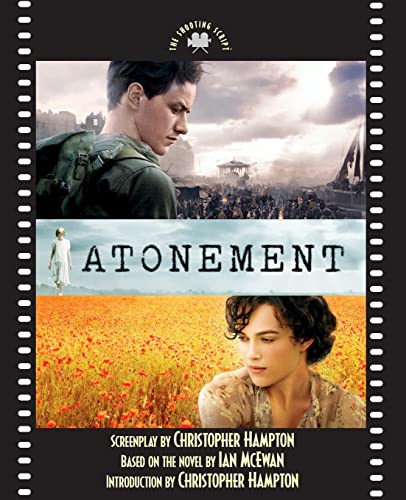
Atonement by Christopher Hampton
Filmed on location in the U.K., the story of Atonement spans several decades. In 1935, 13-year-old fledgling writer Briony Tallis (Saoirse Ronan) and her family live a life of wealth and privilege in their enormous mansion. On the warmest day of the year, the country estate takes on an unsettling hothouse atmosphere, stoking Briony's vivid imagination. Robbie Turner (James McAvoy), the educated son of the family's housekeeper, carries a torch for Briony's headstrong older sister Cecilia (Keira Knightley). Cecilia, he hopes, has comparable feelings; all it will take is one spark for this relationship to combust. When it does, Briony--who has a crush on Robbie-- is compelled to interfere, going so far as accusing Robbie of a crime he did not commit. Cecilia and Robbie declare their love for each other, but he is arrested--and with Briony bearing false witness, the course of three lives is changed forever.
Briony continues to seek forgiveness for her childhood misdeed. Through a terrible and courageous act of imagination, she finds the path to her uncertain atonement, and to an understanding of the power of enduring love.
In addition to the complete script, this Newmarket Shooting Script(R) book includes an exclusive introduction by screenwriter ChristopherHampton, a color photo section, and the complete cast and crew credits.
McEwan likes to take a particularly potent, decisive event bringing the protagonists together -- the snatching of a three-year-old girl in The Child In Time, a tragic ballooning incident at the start of Enduring Love-- and let the emotions develop from there. Atonementis his most deeply emotional book to date, and he is pleased that it turned out a moving love story; he has more often been seen as a master of the gruesome, the disturbing and the morbid after his early novels in the 1970's. His first collection of stories, First Love, Last Rites, was published in 1975 and immediately won him the nickname Ian Macabre. The sense of menace is present from the beginning of his latest novel, and darkness continues through the 1940 sections, but there is a warmth not usually associated with McEwan's work. At my age, he says, there is an obligation to celebrate the good things in life.
He found his own way towards a love of fiction; there weren't many books at home when he was growing up. His father was an Army NCO, and the family moved from London at times to North Germany, North Africa, and Singapore, where as a teenager he would find himself engrossed in novels by Iris Murdoch and Graham Greene. Attending a state-run boarding school, he was the first in his family to get a university education; he was also the first applicant to the creative writing course run by Malcolm Bradbury and Angus Wilson at the University of East Anglia. Now in his mid-fifties, he has published nine novels and two books of short stories. He lives in Oxford with his two sons.
His father, who died in 1996, was a dispatch rider with the Highland Light Infantry and was wounded by shrapnel in both legs during the retreat from Dunkirk; McEwan always knew he would write about it, and he is sorry he wasn't able to show this novel to his father, who became obsessed with his experiences at Dunkirk in his last years. He found another man wounded in both arms and together they managed to ride a Harley-Davidson to safety. The author's mother, who worked as a cleaning lady, is also present in places in the book; she suffers from vascular dementia, a disease that erases the memory, which afflicts Briony late in life.
McEwan feels Briony is the best fictional character he has created yet. Her mistake in telling a lie is the turning point that pulls her from the childhood world of innocence, a theme he has often touched upon. Her shaky claim provides a focus for the class prejudices of her elders, and becomes destructive. I was haunted by the witch-hunts of the recovered memory syndrome in the Eighties and Nineties. Children were prompted by leading questions from earnest social workers and court officials. The situation he created allowed him to address this in an oblique way.
Atonementis about storytelling, and the dangers of applying fictional form to real life, of imposing order and drama on life's confusions; as the Financial Times put it, the power of narrative to create and manipulate truth. If McEwan likes to play with perspective and describe the same experience from several points of view, this is partly because he feels novels are about showing the possibility of what it is like to be someone else. Unlike any other form of art, novels give us the opportunity to get inside someone else's head and try to understand them. Other people are as alive as you are. Cruelty is a failure of imagination.
| SKU | Unavailable |
| ISBN 13 | 9781557047991 |
| ISBN 10 | 1557047995 |
| Title | Atonement |
| Author | Christopher Hampton |
| Condition | Unavailable |
| Binding Type | Paperback |
| Publisher | Newmarket Press,U.S. |
| Year published | 2008-02-01 |
| Number of pages | 118 |
| Cover note | Book picture is for illustrative purposes only, actual binding, cover or edition may vary. |
| Note | Unavailable |