
Centering in Pottery, Poetry, and the Person


The feel-good place to buy books
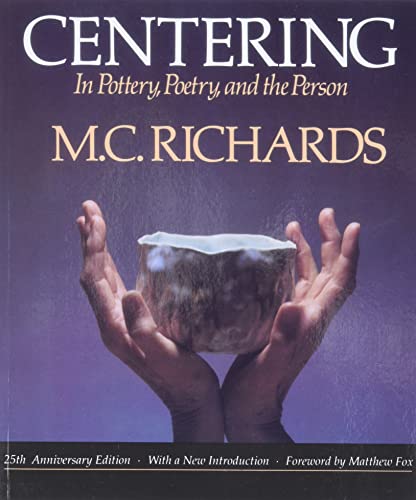
Centering in Pottery, Poetry, and the Person by Mary Caroline Richards
A flowing collection of poetry that is also a guide for life.Richards (1916 - 1999) was a poet, potter, writer, translator, and painter who taught at Black Mountain College in the late 1940s and became an outspoken champion for community in both art and life. An artist who wrote poetry about pottery and built pots inspired by her reading, Richards was perhaps best known for Centering in Pottery, Poetry, and the Person, a collection of essays published by Black Mountain College in the late 1940s. The book, which went on to become a cult classic, brought together themes about perception, craft, education, originality, religion, and spirituality, arguing for the richness of daily experience if paid attention to, as well as the average person's creativity. Richards wrote that poets aren't the only ones who write poetry. Mary Caroline Richards was born in Weiser, Idaho, and raised in Portland, Oregon. In 1937, she graduated from Reed College with a bachelor's degree in literature and languages and a thesis titled Tang Dynasty Poetry in Connection to Western Imagism. She went on to study Chinese and earn her Ph.D. at the University of California, Berkeley.
In 1942, I wrote a dissertation on Thomas Hardy's irony. After a brief marriage, she went on to teach English at the Central Washington College of Education in Ellensburg, Wash., and the University of Chicago. In 1945, she married Albert William Levi Jr, a social scientist who had been invited to join the faculty of the experimental Black Mountain College near Asheville, N.C. Josef and Anni Albers, John Cage, Merce Cunningham, David Tudor, Robert Rauschenberg, and Charles Olson were among the professors and students at Black Mountain, which was a short-lived laboratory for creative teaching and art. At Black Mountain, Richards taught writing, produced, and, when necessary, translated plays by Cocteau, Satie, and Yeats. She also studied pottery and danced with Robert Turner.
With Cage, Olson, Rauschenberg, and Franz Kline, she took part in what could have been the first event in 1950. She left her husband in 1951 and moved to New York with Tudor in 1952. She studied ceramics at Greenwich House in Greenwich Village, attended meetings of the downtown avant-garde known as the Club, and worked on the first English translation of Antonin Artaud's landmark Theater and Its Double, which was published by Grove Press in 1958. Richards worked in a workshop with Karnes for a decade, developing a type of flame-proof clay that allowed them to produce ceramic cookware. In the early 1960s, Richards began teaching pottery workshops.
With titles like Clay and Language, Clay and Dance, and Clay and Eurythmy, they became increasingly interdisciplinary, reflecting the themes that would figure in Centering. She gave talks and seminars in schools around the United States, Canada, and the United Kingdom. The Crossover Point (1973), Expanding Our Moral Eye (1996), and Toward Wholeness: Rudolf Steiner Education in America, a work of social philosophy, were among Richards' writings, which sometimes mingled prose and poetry. Richards, who has no survivors, added painting to her list of interests in 1989. The Camphill community in Kimberton is one of 80 worldwide founded on Steiner's ideas.
She then combined ceramics, poetry, and paintings in exhibitions, the most recent of which was in 1997 at the Works Gallery in Philadelphia. Her work will be shown in a retrospective at the Worcester Center for Crafts in Massachusetts, which will debut on October 1. 9. There will be a public memorial. Richards embraced old age with her trademark candor, producing a poem in 1997 in which she imagined herself as withering and flowering into oblivion.
| SKU | Unavailable |
| ISBN 13 | 9780819562005 |
| ISBN 10 | 0819562009 |
| Title | Centering in Pottery, Poetry, and the Person |
| Author | Mary Caroline Richards |
| Condition | Unavailable |
| Binding Type | Paperback |
| Publisher | Wesleyan University Press |
| Year published | 1989-05-01 |
| Number of pages | 187 |
| Cover note | Book picture is for illustrative purposes only, actual binding, cover or edition may vary. |
| Note | Unavailable |